





What we look at on a first visit to a Reigate house
Reigate lies at the foot of the North Downs, with Reigate Hill rising directly behind the town. Its houses range from large Victorian homes on the hill to later streets out towards Woodhatch. The first visit from CRB Roofing Building Ltd is free. Our roofers are third generation, the firm is family run, and they walk round the building in the same order every time.
- The roof covering. Slipped, cracked and missing slates or tiles, loose ridge tiles, and moss holding water against the surface.
- The leadwork. Flashings where a slope meets a wall or chimney, the valleys between slopes, and any lead that has split, lifted or been patched with sealant.
- The roofline timber. Fascias, soffits and bargeboards for soft spots and flaking paint, and gutters for dripping joints or lengths that have dropped out of line.
- The joints in stone and brick. Mortar washed out of chimneys, gable ends and garden walls, and any stone or brick face that has begun to flake.
You then receive a quotation, free and with no obligation, setting out what needs doing now and what can safely wait.
Roof Repairs in Reigate: what we put right
Most calls about a roof begin indoors, with a brown stain on a bedroom ceiling or a drip in the loft after a night of rain. The cause is usually smaller than the stain suggests: a slate whose nail has rusted through, a tile cracked across, or a strip of flashing pulled out of the brickwork.
Our roof repairs cover leaking roofs, missing or broken tiles and slates, flashing and leadwork that has been damaged, and the gutter and roofline faults that send rainwater down the wall. On a period roof we match each replacement slate or tile to the ones around it, so the repair is hard to pick out from the road.
Emergency roof repairs are available when a storm has opened a roof up.
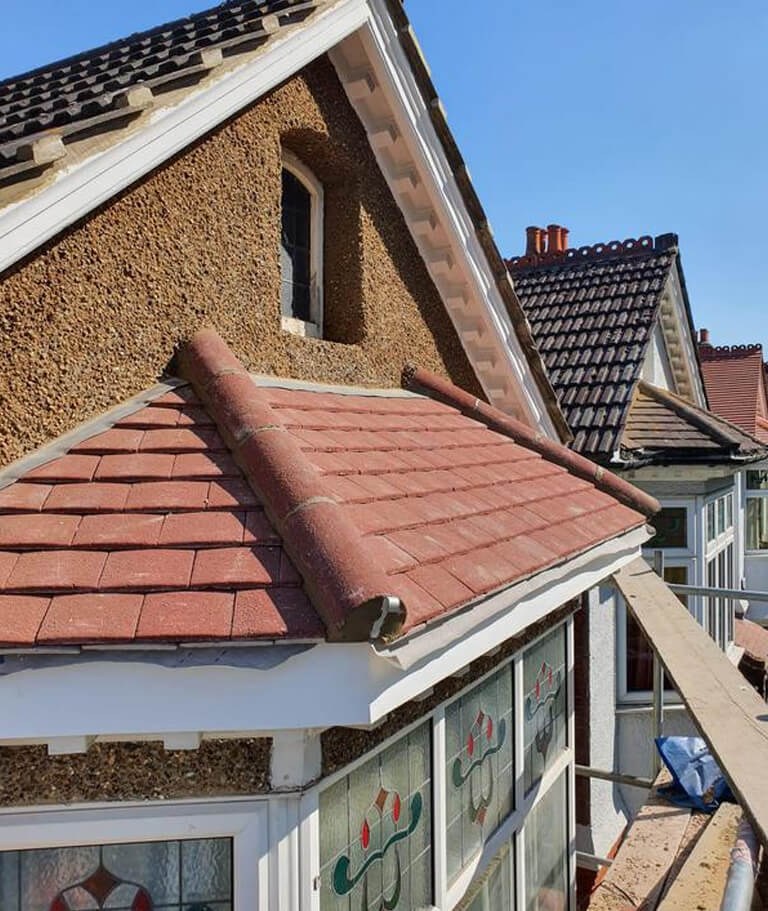
Facias Replacement in Reigate
The fascia is the long board at the foot of the roof slope that the gutter hangs from. The soffit closes the gap beneath it, and bargeboards finish the sloping edges of a gable. All three are easy to ignore until the paint goes. After that the timber takes in water, the gutter brackets lose their hold and rain starts to spill down the brickwork instead of reaching the downpipe.
We replace fascias, soffits and guttering as one job: new uPVC boards, new gutters and downpipes, box ends and bargeboards. With the old boards off, the rafter ends and the bottom edge of the roof can be checked before anything new is fixed. Where the only fault is a blocked or sagging gutter, we clear it and set it back in line.
Victorian houses in Reigate often have deep eaves and shaped bargeboards, so we agree the board depth and colour with you before ordering.
Chimney Repairs for Reigate’s older houses
A chimney stands above everything else on the roof and takes the weather from all sides, and Victorian houses often have more than one. The warning signs are mortar missing between the bricks, a pot that has shifted, plants rooting at the top, or a damp patch on the chimney breast indoors. Our chimney repairs include repointing, rebuilding, capping and removal, and we renew the lead at the base: the step flashings and the cover flashings over them.
Damp Proofing in Reigate homes
Damp has three common causes, and each needs a different answer, so we begin with a survey. Rising damp is drawn up from the ground into the foot of a wall. Penetrating damp gets in from outside, by way of worn pointing, a dripping gutter or soil banked against a wall where a house is cut into sloping ground. Condensation is moisture from daily life settling on cold surfaces. Our damp proofing work may then be a damp proof course injected into the wall, a waterproof membrane or tanking, a treatment for the outside face, or better ventilation.
A New Roof in Reigate
When the same roof needs attention winter after winter, the money is better put towards a new covering. Our new roofs are laid in slate and in clay or concrete tile, and we reconstruct roofs that are past repair. The scaffolding is our own, and on new roofs we supply it and put it up without charge.
Reigate has several conservation areas. If your house is in one, or is listed, speak to the council before changing the roof covering. We can help with planning applications and surveys.
Flat Roofing in Reigate for extensions and garages
Flat roofs over extensions, garages and outbuildings are the roofs most easily forgotten. Standing water, blisters, splits along the edges and felt lifting where the roof meets a wall are the signs to act on. We repair and replace flat roofs for homes and commercial premises, and the coverings we lay are GRP fibreglass, EPDM rubber, felt and torch on systems.
Brick Repointing on Reigate walls and chimneys
In a sound wall the mortar weathers first and spares the brick. When the joints have gone back far enough to hold water, it is time to repoint, whether that is a whole elevation, a chimney, a parapet or a boundary wall. The old mortar is cut out and new mortar, mixed to match the colour, goes in. Our brick repointing on heritage and listed buildings follows traditional methods where the wall needs them, for the reason given in the second question below.
Property Refurbishment in Reigate
Roof and wall repairs often lead on to work indoors, and the same team can carry it out: replastering a ceiling, decorating, rendering a wall, laying a floor, tiling, or updating a kitchen or bathroom. Structural improvements are part of our property refurbishment service too. With one firm looking after the outside and the inside, a ceiling is not replastered until the leak above it has been fixed.
Questions about roofs and walls in Reigate
Should I have timber or uPVC fascias on a period house?
uPVC needs no painting and is what we fit on most houses. If your home is listed or stands within one of the conservation areas, ask the council before changing the material, because painted timber may be part of what is protected.
Why does soft local stone need the right mortar?
Reigate stone, a soft sandstone once quarried from the hills north of the town, was used on some of the older buildings and is known to weather badly. Mortar should always be a little softer than the stone or brick beside it, so that moisture leaves through the joint. A hard cement mix does the opposite. Water is held in the stone, frost works on it and the face begins to come away. That is the reason older walls are repointed with a traditional mortar.
When does a roof repair stop being worth it?
A repair makes sense when the fault is local: a few slates, one flashing, one valley. It stops making sense when slates are slipping all over the roof because their fixings have rusted, when the felt beneath has perished, or when the battens are rotten. At that point each repair only moves the leak somewhere else.
Book a free site visit in Reigate
CRB Roofing Building Ltd is fully insured with public liability cover and all our work is guaranteed. Every job is carried out by our own team, and we are Trustatrader approved. We work in Redhill too, the next town to the east. To arrange a visit, contact us.