




How East Grinstead is built
East Grinstead is a market town on a ridge in the High Weald of West Sussex. The timber framed buildings along its High Street form an unbroken row that few streets in England can match for length, and the street lies in a conservation area. Sackville College, a sandstone almshouse of the early 1600s, stands at the eastern end of the same street.
Beyond the old centre the town is brick, sandstone and tile hanging, under roofs of clay tile and, on a few of the oldest buildings, Horsham stone. Felbridge lies to the north west and Ashurst Wood to the south east. A ridge is an exposed place to build, and the mortar between the bricks is what the weather wears away first. CRB Roofing Building Ltd is run by a family now in its third generation of roofers, and our own team does the work.
Brick Repointing in East Grinstead
Brick repointing means taking out worn mortar and putting new mortar in its place, so that the wall sheds rain again. Done properly it goes in five stages.
- 1. Assess. The whole wall is looked at, not only the worst patch. What is it built of, what was the first mortar, and why have the joints failed? The cause may be age, a leaking gutter above or an earlier repair in the wrong material.
- 2. Rake out. The old mortar comes out to a sound depth without chipping the edges of the bricks or widening the joints. Soft old brick and sandstone need a slow, careful hand.
- 3. Mix and match the mortar. New mortar is made to suit the wall. It should be a little weaker than the brick or stone beside it, and the sand is picked so the colour matches what is already there.
- 4. Point. Each joint is packed full from the back, then finished to the same shape as its neighbours so the repair does not stand out.
- 5. Clean down. The face is brushed off and the fresh mortar is shielded from rain, frost and strong sun while it hardens.
We repoint chimneys, parapets, garden and boundary walls and complete house elevations, heritage and listed buildings among them, with traditional methods used where an older wall needs them. On a tile hung house the upper walls are covered, which leaves the ground floor brickwork and the chimney open to the weather.
Chimney Repairs in East Grinstead
The chimney is the most exposed brickwork on any house, and on a ridge it meets the wind from every direction. Rain is driven into the joints, frost opens them up, and the mortar ends up in the gutter. The signs to watch for are a damp patch on the chimney breast upstairs, grit or lumps of mortar on the roof below the stack and a pot that leans.
Under our chimneys and leadwork service we repoint, rebuild, cap and remove chimneys and repair their flashings. If the bricks are sound and the stack stands straight, repointing and new lead flashing are usually enough. If the bricks have crumbled or the stack leans, the loose part comes down to solid brickwork and is built up again. A flue with no fire beneath it can be capped so that rain stays out and air still passes through.
Lead matters as much as mortar. The flashings seal the joint between the stack and the tiles, and we repair or renew them along with lead valleys and box gutters. The tall stacks on the older houses near the High Street are part of the character of the conservation area, so they are repaired like for like.
Roof Repairs in East Grinstead
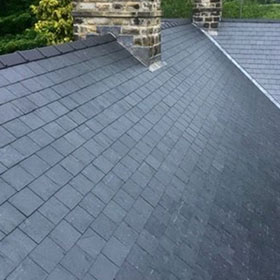
Most roofs in the town are clay tile, and the same tiles hang on many upper walls. Our roof repairs deal with storm damage, leaks, broken or missing slates and tiles, worn leadwork and faults along the gutters and roofline. New tiles are matched to the old. Horsham stone roofs are rare and very heavy, and one of those needs a specialist survey before anything is touched.
New Roof in East Grinstead
A roof that has been patched many times, or whose tiles are worn across whole slopes, is better replaced. We install new roofs in slate and tile, build roof extensions and reconstruct roofs where the timbers call for it. The scaffolding is our own and is put up free of charge on a new roof. For a house in the conservation area we can help with the planning application.
Flat Roofing in East Grinstead
Extensions, garages, dormers and outbuildings usually have a flat roof. The coverings we use for flat roofing are felt, torch on systems, rubber (EPDM) and fibreglass (GRP). A repair may mean tracing a leak and sealing it, patching a blister or a tear, reinforcing a joint or an edge, or giving the roof better drainage. Where a flat roof meets a brick wall, the flashing and the pointing above it are checked together, since that joint lets in more water than any other.
Facias Replacement in East Grinstead
Fascias and soffits close off the ends of the rafters and hold up the gutters. On an exposed site painted timber needs regular upkeep, and once rot sets in the gutter brackets lose their grip. We fit fascias and soffits in uPVC, put up new gutters and downpipes, and replace bargeboards and box ends. An overflowing gutter soaks the wall beneath it and washes out the pointing, so it is worth fixing early.
Damp Proofing in East Grinstead
Rain that gets into open joints shows indoors as penetrating damp, and the cure is on the outside of the wall. Rising damp and condensation have other causes, so damp proofing starts with an inspection. The treatments we offer are damp proof courses by injection, waterproof membranes and tanking, treatments to external walls and upgraded ventilation.
Property Refurbishment in East Grinstead
Our property refurbishment work takes in structural improvements, updated kitchens and bathrooms, rendering and plastering, tiling, flooring and decorating, with the roof and chimney repaired where needed. On a larger project we can also help with project management, structural engineering and architectural drawings.
Repointing questions
Should an older wall be repointed in lime or cement?
Lime, in most cases. Walls built before cement became common were laid in lime mortar, which is softer than the bricks and lets the wall dry out through its joints. Cement is harder and holds water back, so the water leaves through the bricks instead and frost then breaks their faces off. A house built with cement mortar from the start is repointed in a cement based mix to match.
How can I tell that pointing has failed?
Sound mortar sits close to the face of the brick and resists a key drawn across it. Failed mortar is set well back, crumbles to sand, or has holes and open cracks. Other signs are a line of sandy dust at the foot of the wall, plants rooting in the joints and damp patches indoors on an outside wall.
Can a chimney be repointed without a full scaffold?
It depends on the stack. A low chimney near the eaves of a shallow roof can sometimes be reached safely from a small tower or a scaffold built only around the chimney. A tall stack at the ridge of a steep roof needs more. The height, the pitch, the state of the brickwork and what lies below all count, and we judge them on a site visit, which is free. The scaffolding is our own.
We guarantee our work and hold public liability insurance. Contact us for a free quotation with no obligation.