





Roof Repairs in Crystal Palace: what to check after high winds
Crystal Palace stands on high ground on the Norwood ridge, and its roofs catch wind that streets lower down never feel. As roofers, our advice after any gale is to walk round the outside of the house and look up. Five things can be checked from the ground, with binoculars if you have them. Leave the ladder where it is.
- Ridge line. The tiles along the top should run in a straight, unbroken row. A gap, or a tile sitting at an angle, means the mortar has let go.
- Slates. Look for dark rectangles where a slate has gone, slates lying crooked, and broken pieces in the gutter or on the path.
- Flashing. The lead where the roof meets a chimney or a wall should lie flat. A lifted edge lets rain straight in.
- Gutters. Check for lengths that sag, brackets pulled away from the board and joints that have parted.
- Chimney pots. A pot that leans, or a cowl that has vanished, needs attention before the next storm.
If anything has changed since you last looked, ring us: London 020 8945 7505, Onsite 07778 272228.
How repairs are made on tall Victorian houses
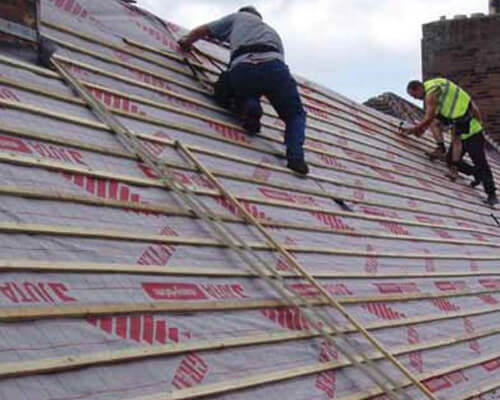
After the Crystal Palace was rebuilt on this hilltop in the 1850s, the roads around it filled with large Victorian villas. Many are three storeys or more, with steep slate roofs and heavy chimney stacks. A repair at that height starts with safe access. Once we can reach the roof, cracked slates and tiles are swapped for sound ones and gaps are filled, split or lifted lead is dressed back or renewed, and faults along the gutters and eaves are put right. After a storm we treat the call as an emergency. See our page on repairing roofs for the faults we deal with.
About CRB Roofing Building Ltd
Ours is a family business, now in its third generation. Roofing and building work is done by our own staff. We hold public liability insurance, guarantee our work, and give free quotations after a free site visit. We work for people who own their homes, for landlords and for businesses, in South London and across the South East.
Several London boroughs meet at Crystal Palace. The Upper Norwood Triangle, formed by Westow Hill, Westow Street and Church Road, is a conservation area, and it sits beside the conservation area that covers Crystal Palace Park. Anerley lies down the hill, with Beckenham and Bromley beyond.
Flat Roofing in Crystal Palace
On an exposed hilltop the edges of a flat roof matter most. Wind gets under a loose trim or an unsealed lap and starts to peel the covering back, and rain follows. When we repair a flat roof we secure the perimeter and the joints, seal leaks, cut out and patch blisters and tears, and improve the falls and outlets so water clears quickly.
Where a flat roof is past repair a new one goes down in rubber (EPDM), fibreglass (GRP), felt or torch on felt. Extensions, garages and outbuildings are all covered, on homes and commercial premises. The systems we fit are listed on the flat roofs page.
New Roof in Crystal Palace
A roof that is patched after every winter eventually takes more looking after than it is worth. We build pitched roofs in new slate or tile, lay flat ones, extend roofs and reconstruct them completely.
The scaffolding is our own, and on a new roof we make no charge for it. In and around the Triangle conservation area the council may expect natural slate or a matching tile, and it is best to ask before ordering. A chimney can be reconstructed or demolished during the same project. Find out more under new roof installations.
Chimney Repairs in Crystal Palace
A chimney is the most exposed part of any house, and on this ridge it meets the wind from every quarter. Frost and driving rain wear the mortar away first, then loosen the pots and the mortar bed that holds them. Watch for a stack that leans, cracks running through the brickwork or fragments of mortar on the roof below.
Our work covers repointing, rebuilding where the brickwork has failed, taking down disused stacks and capping open flues. At the base, the stepped lead and its cover pieces are repaired or replaced so that water cannot get in where the stack passes through the roof. For valleys and box gutters in lead, see chimney repairs and leadwork.
Property Refurbishment in Crystal Palace
Large Victorian houses, whether kept whole or divided into flats, need work inside as well as out. Our refurbishment work takes in structural improvements, bathroom and kitchen updates, tiling, new floors, plaster, render and paint, and anything the roof or the stacks need can go into the same programme. On a large scheme we can also organise the surveys and drawings, involve a structural engineer and run the project. Take a look at refurbishing a property.
Brick Repointing in Crystal Palace
Driving rain on a hillside tests every mortar joint. Where joints have weathered back we remove the loose mortar and repoint with a mortar matched in colour to the original. Entire house walls, garden walls, parapets and stacks can be done, and on a heritage building we work in the traditional way where that is needed. We also render. Go to repointing brickwork for more.
Damp Proofing in Crystal Palace
Houses built into a slope often have one wall with earth against it, and that is where damp tends to appear. We start with a damp survey and inspection. Rising damp calls for a new damp proof course, injected into the wall. Rooms below ground are tanked or given a membrane lining. Damp coming through from outside is dealt with by treating the wall face, and condensation by upgrading the ventilation. Read more about treating damp.
Facias Replacement in Crystal Palace
High winds work on gutters as well as slates. Brackets fixed into soft, rotten fascia boards pull out, and the gutter drops. We take off worn boards and fit new fascia and soffit boards in uPVC, hang new guttering with its downpipes, replace bargeboards and box ends, and unblock and straighten gutters that are worth keeping. Details are under fascias and soffits.
Questions about roof repairs in Crystal Palace
Is one slipped slate urgent?
It is worth acting on soon, though it is rarely an emergency on the day. A single gap lets rain reach the felt or the timber beneath, and the wind now has an edge to lift the slates beside it. On a hilltop the next gale can turn one missing slate into several, and a small repair becomes a larger one.
Can a tall house be repaired without full scaffolding?
Sometimes. It depends on the height, the pitch of the roof, where the damage is and what lies below it. We decide on a site visit, with safety first. Because we own our scaffolding, it can go up without waiting on another firm when it is needed.
Which council do I ask about consent?
The one you pay council tax to. Because several boroughs meet here, neighbours on opposite sides of a road can come under different councils with different conservation area rules. Your council tax bill names the right one, and its planning team can tell you whether your address is in a conservation area or the building is listed.
Quotations are free. Write to us from the contact page if you would sooner not phone, and see area coverage for the other places we work.