




Flat Roofing in Brixton: the four systems compared
Brixton has more flat roofs than you would guess from the pavement. They cover the back additions of Victorian terraces, the upper floors above shops in the town centre and the tops of mansion blocks. CRB Roofing Building Ltd fits and repairs four types of flat roof covering. The right one depends on the size and shape of the roof and on what lies beneath it.
Felt
Modern roofing felt goes down in layers, with a mineral finish on the top sheet. It copes well with roofs that have plenty of edges, outlets and upstands, because each layer can be cut and dressed around them. Felt suits the long, narrow roofs over back additions.
Torch on felt
Here each sheet is heated with a gas torch so that its underside melts and the layers weld together. The result is a thick, tough covering for larger roofs, such as those over shops and blocks of flats. Because a flame is involved, the work has to be planned with care around timber and neighbouring buildings.
EPDM rubber
EPDM is a sheet of synthetic rubber, glued down cold. On a small roof it can often be laid in one piece, which leaves few or no joints for water to find. It is light and flexible and suits plain rectangles such as a kitchen extension or a garage. A roof with many corners and pipes needs more joints.
GRP fibreglass
GRP is built up on site from resin and glass fibre matting over new boards, then sealed with a top coat. It cures into one hard shell without seams, strong enough to walk on for maintenance. It handles awkward shapes well and suits small and medium roofs. It needs a dry day to be laid.
We look at the roof, and at the room below it, before recommending one. There is more detail on our flat roofing page.
Roofers in Brixton
We are third generation roofers and a family run firm, working across South London and the South East for homeowners, landlords and commercial clients. Every job is carried out by our own team. We are fully insured with public liability cover, our work is guaranteed, and quotations and site visits are free.
Brixton is in the London Borough of Lambeth. Its town centre, with the markets, the Town Hall and the mansion blocks on Electric Avenue and Rushcroft Road, is a conservation area. Victorian terraces fill the side streets off Brixton Hill, late Georgian terraces survive along Brixton Road, and large estates built after the war stand beside both. Herne Hill lies to the south, with Camberwell and Peckham to the east.
Roof Repairs in Brixton
A flat roof that leaks does not always need replacing. Where the covering is sound overall, we trace the leak and seal it, mend tears and blisters, strengthen edges and joints, and improve the drainage so that rain runs off.
On pitched roofs we replace missing and broken slates and tiles, repair damaged flashing and leadwork, and put right faults in the guttering and roofline. Damage from storms is treated as an emergency. Some of the older terraces have a valley gutter hidden behind the front parapet, and a blocked or split valley is a common cause of damp patches on a top floor ceiling.
The full list is on the roof repairs page.
Chimney Repairs in Brixton
The tall stacks on Victorian terraces take the weather from every side. We repoint chimneys, rebuild stacks that have become unsafe, remove chimneys that are no longer wanted and cap flues that are out of use. Where a stack meets the roof we repair or renew the lead flashing, including step and cover flashings. Lead valleys and box gutters are covered on our chimneys and leadwork page.
Damp Proofing in Brixton
Damp in an older terrace has three usual causes. Rising damp comes up through the walls at ground level. Penetrating damp comes in from outside, often below a leaking gutter or failed pointing. Condensation forms where warm, moist air meets a cold surface. We begin with a damp survey to find which one is at work, because each has a different cure. Treatments include an injected damp proof course, tanking and waterproof membranes for basements, external wall treatments and better ventilation. Our damp proofing page lists them all.
A New Roof in Brixton
When a roof has come to the end of its life, we strip it and build a new one. That covers pitched slate and tile roofs, new flat roofs, roof extensions and full reconstructions, with chimneys rebuilt or taken down as part of the job where needed. We own our scaffolding, and on new roofs it is supplied and put up free of charge. Inside the conservation area the council may expect the new covering to match the old, so check with Lambeth's planning team before materials are ordered. Our new roofs page has more.
Brick Repointing in Brixton
Soft, crumbling mortar lets rain into the wall behind it. We rake out the old mortar and replace it with new mortar matched for colour, on full house fronts, boundary walls, chimneys and parapets. Older brickwork was built with softer mortar than a modern house, and we use traditional methods where the building calls for them. Rendering is available too. Read more about brick repointing.
Facias Replacement in Brixton
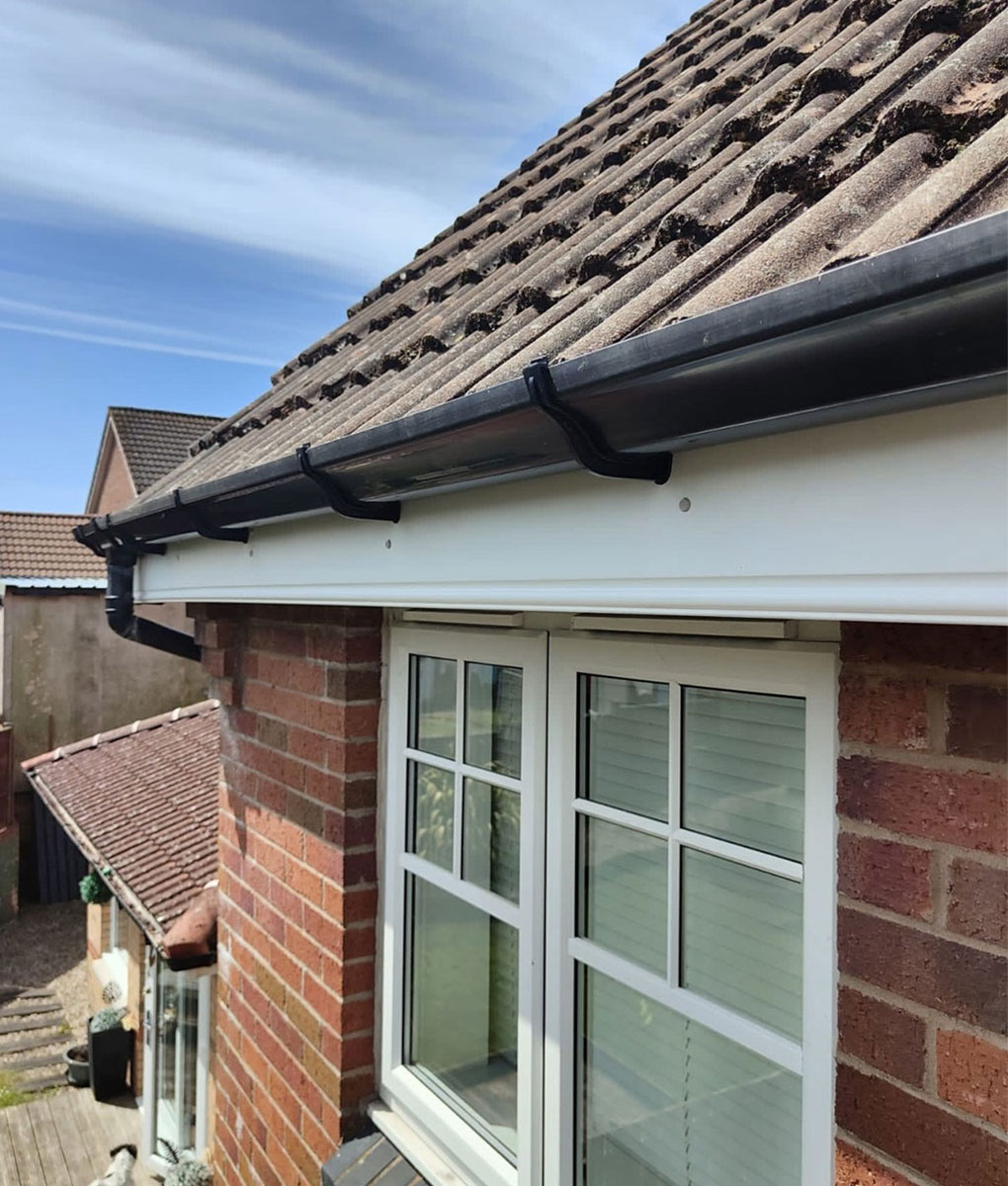
Fascias are the boards that carry the gutter along the edge of the roof, and soffits close the gap beneath them. When they rot, the gutter sags and water runs down the wall. We fit uPVC fascias and soffits, repair and replace gutters and downpipes, renew box ends and bargeboards, and clear and realign gutters that have stopped draining. Details are on our fascias, soffits and guttering page.
Property Refurbishment in Brixton
Roof and damp problems tend to leave their mark indoors. Once the building is dry our team can carry on inside with plastering, rendering, decorating, new flooring and tiling, updated kitchens and bathrooms, and structural improvements. On larger projects we can help with surveys, drawings, project management and structural engineering. See property refurbishment.
Questions about flat roofs in Brixton
My flat roof holds water after rain. Should it be repaired or replaced?
Standing water tells you the roof has lost its fall or an outlet is blocked. If the covering is still in good condition and the deck beneath feels firm, clearing the outlet and improving the drainage may be all it needs. If the boards have sagged, or the surface has been patched several times, a new roof laid to a proper fall is usually the sounder choice.
Which system is best for a small extension?
For a plain rectangle with few details, EPDM rubber and GRP fibreglass both work well, because either can cover the roof with few or no joints. Felt remains a good choice where there are rooflights, pipes or several upstands. We advise once we have seen the roof.
I own a flat in a block. Who do I need to tell before work starts?
Check your lease first. In most blocks and converted houses the roof belongs to the freeholder, even where it sits directly above your flat, and repairs are arranged through the freeholder or the managing agent. Report the leak to them in writing and ask how they want the work quoted. We work for landlords and commercial clients as well as homeowners, so we can quote for whoever is responsible.
For a free quotation call London 020 8945 7505 or Onsite 07778 272228, or use our contact page. The other places we work in are listed on our serviced areas page.