





Is the damp coming from the ground, the wall or the roof?
That is the first thing to settle in a Battersea terrace, because each answer has a different cure. Battersea lies on low ground on the south bank of the Thames, in the London Borough of Wandsworth, and most of its streets are Victorian terraces that stretch south towards Clapham Common. Their walls are generally solid brick with no cavity, and a good number of their roofs drain through a gutter you cannot see from the road.
Where the damp shows is the best clue to its source:
- Low on a ground floor wall: moisture is most likely rising from the ground.
- Part way up an outside wall, darker after rain: water is getting through the brickwork, often below a gutter, a pipe or tired pointing.
- On a top floor ceiling or chimney breast: look to the roof.
CRB Group is in its third generation of roofers and builders, and the same team carries out damp proofing and roof repairs in Battersea, so you get one opinion on the cause and one plan to deal with it.
Damp Proofing in Battersea
A solid brick wall has nothing behind the outer face to stop moisture travelling inwards. It stays dry only while the damp proof course at its base is working and the ground outside sits below that line. Over the years paths get raised, flower beds are banked against the house and render is carried down to the pavement. Any of these can bridge the damp proof course and let ground water climb the wall. Lower floors and cellars have an added problem, because soil rests directly against the brickwork.
We begin with a damp survey and inspection. From there we recommend the treatment that fits: better ventilation where condensation is to blame, a treatment to the outside of the wall, a damp proof course injected into the brickwork, or a membrane or tanking for a room below ground level. Our damp proofing page goes through the signs to watch for.
Roof Repairs in Battersea
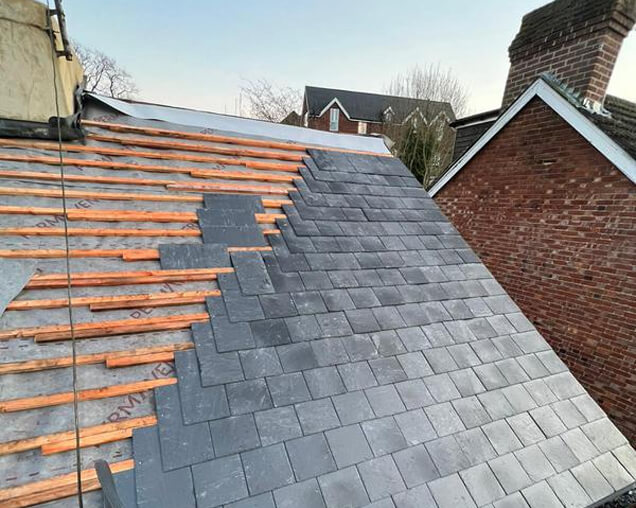
Battersea terraces have two sorts of roof. The first is the familiar pitched slate roof with its ridge running along the street. The second is hidden behind a parapet at the front: two slopes fall inwards to a central valley gutter, and all the rain that lands on the house leaves through that one lead lined channel towards the back. When leaves and silt block it, the water has nowhere to go and finds its way under the slates.
Our roof repairs deal with leaking roofs, broken or missing tiles and slates, damaged flashing and worn leadwork, and that includes box gutters and lead valleys. Roofline and guttering faults are put right as well, and after storm or weather damage we offer emergency roof repairs.
The Shaftesbury Park Estate is a conservation area: streets of two storey cottages in stock brick, with Gothic touches, put up in the 1870s as homes for working families. In an area like that it is wise to ask the council before changing any roofing material that shows from the street. Our roof repairs page explains what we look at.
Flat Roofing in Battersea
The back addition of a terrace, and the kitchen extension beyond it, will usually have a flat roof. Damp on the rear wall of the house often starts where that roof meets the brickwork. On extensions, garages and outbuildings we lay felt, torch on, GRP fibreglass and EPDM rubber roofs, and we repair all of them. That can be a leak to trace and seal, a tear or blister to patch, an edge or joint to reinforce, or drainage to improve so that water runs off. Our flat roofing page describes each material.
New Roof in Battersea
A slate roof that sheds slates every winter has generally reached the point where a new roof makes more sense than another repair. We reconstruct roofs, lay new flat roofs and install new pitched roofs in tile or slate. Because the scaffolding belongs to us, there is no charge for supplying it and putting it up when we fit a new roof. Find out more on our roofing page.
Brick Repointing in Battersea
With no cavity to fall back on, a solid wall relies on its pointing to keep the rain out. Parapets on valley roofs have it hardest, since both of their faces are open to the weather. We repoint whole elevations and boundary walls, and chimneys and parapets too, taking out the old mortar and replacing it with mortar matched in colour to the original brickwork joints. How to tell when repointing is due is covered on our brick repointing page.
Chimney Repairs on Battersea Terraces
Terraced houses share their chimney stacks along the party wall, so a fault in one stack can show up as a damp chimney breast in two homes. Chimney repairs we carry out include repointing and rebuilding stacks, capping, removing chimneys and renewing step flashings and cover flashings in lead. Our chimneys and leadwork page has more on this.
Facias Replacement and Guttering in Battersea
We clear gutters and set them back in line, replace or repair downpipes and gutter runs, and fit uPVC soffits and fascias with new bargeboards and box ends. Our page on guttering, fascias and soffits has the detail. It is worth doing promptly: a gutter that sags or leaks at a joint soaks the wall below it, and that is one of the simplest causes of damp to put right.
Property Refurbishment for Battersea Homes
After a leak or a spell of damp has been cured, the room usually needs putting back together. We can plaster and render the walls, tile and lay floors, paint and decorate, update the kitchen or bathroom and take on structural improvements if they are called for. The full list is on our property refurbishment page.
Questions about damp and roof leaks in Battersea
How do I tell a roof leak from rising damp?
Go by height and timing. Rising damp stays near the bottom of ground floor walls and changes slowly through the seasons. A roof leak appears on the top floor, on a ceiling or a chimney breast, and worsens within hours of heavy rain. A patch half way up the house is usually neither of these: check the gutters, downpipes and pointing outside.
What does a blocked valley gutter do?
The water level in the gutter rises until it tops the edge of the lead lining and runs beneath the slates on either side. The first sign indoors tends to be a brown stain along the middle of the top floor ceiling. Caught early, clearing the gutter and checking the lead solves it. Left alone, the boards and timbers under the gutter start to rot.
Can landlords book a survey for a let flat?
Yes. Landlords can book in the same way as homeowners, and we work for commercial clients too. The property might be a converted terrace or a flat in one of the mansion blocks on Prince of Wales Drive, facing Battersea Park. All we need is a time agreed with your tenant for access.
Free quotations
CRB Roofing Building Ltd is a family run firm. Our own team carries out every job. We carry public liability cover, the work is guaranteed and we are Trustatrader approved. Quotations and site visits are free.
To book a visit, ring London 020 8945 7505 or Onsite 07778 272228. Our area coverage page shows where else we work.