





Refurbishing an Edenbridge house: start with its age
Edenbridge is a Kent town on the River Eden, and its buildings span several centuries within a short walk. What a refurbishment has to deal with first depends on when the house was built, so that is where CRB Roofing Building Ltd begins.
Timber framed buildings on the High Street
The High Street has medieval timber framed buildings, one of which is home to the Eden Valley Museum. With a building of this age the structure comes first: the condition of the frame, the panels between the timbers and the load the roof puts on them. Many old buildings are listed, so consent has to be in place before work begins. Old frames also need materials that let moisture out, which rules out a good many modern plasters and paints.
Victorian and later houses towards Marlpit Hill
Marlpit Hill, north of the old centre, became part of the town as it grew after the railways came. Houses from these years usually have solid brick walls and slate or clay tile roofs. Damp and the roof are the first things to look at. Solid walls rely on sound pointing to keep rain out, and the original roof coverings are often at the end of their working life.
Estates built after the war
The estates at Stangrove Park and Spitals Cross were built by the London County Council. Houses of this period are generally sound in structure. The usual starting points are the roof covering, the fascias and gutters, and condensation where ventilation is poor, followed by kitchens and bathrooms that are due for renewal.
Property Refurbishment in Edenbridge
Our property refurbishment service brings the trades a house needs under one firm. It covers plastering and rendering, painting and decorating, flooring and tiling, roof and chimney repairs, structural improvements, and kitchen and bathroom updates.
Every job is carried out by our own team, so the trades follow one another in the right order and you deal with one firm throughout. For larger schemes we can help with planning applications and surveys, architectural drawings, structural engineering and project management.
We work for homeowners, landlords and commercial clients, and the first site visit and quotation are free.
Brick Repointing in Edenbridge
Repointing is often the first outside job on a refurbishment, because worn joints let rain into the wall and no work indoors will last while they do. The old mortar comes out and fresh mortar of the same colour goes back. Our brick repointing covers complete elevations as well as chimneys, parapets and boundary walls, and on listed and heritage buildings we work by traditional methods where required.
Damp Proofing in Edenbridge
The town centre lies on the flood plain of the Eden and has flooded in the past, and low ground beside a river stays wet for longer. In any older house here it pays to know where moisture is coming from before money is spent on finishes.
Our damp proofing begins with a damp survey and inspection to tell rising damp, penetrating damp and condensation apart. Treatment may be an injection damp proof course, tanking or a waterproof membrane, an external wall treatment or improved ventilation.
New Roof in Edenbridge
If the roof is near the end of its life, replacing it at the start of a refurbishment protects everything done beneath it. We install new roofs in slate and tile, carry out roof reconstructions and roof extensions, and lay new flat roofs. We own our scaffolding, which is supplied and put up free of charge on new roofs and renovations. On an older building we can match tiles and restore a heritage roof in keeping with the original.
Roof Repairs on Edenbridge homes
Not every roof needs replacing. Where the covering is sound overall, we repair the faults: a leak, a handful of cracked or missing tiles, a flashing that has come away, damage left by a storm. Roof repairs are best finished before any plastering or decorating starts on the floor below.
Facias Replacement in Edenbridge
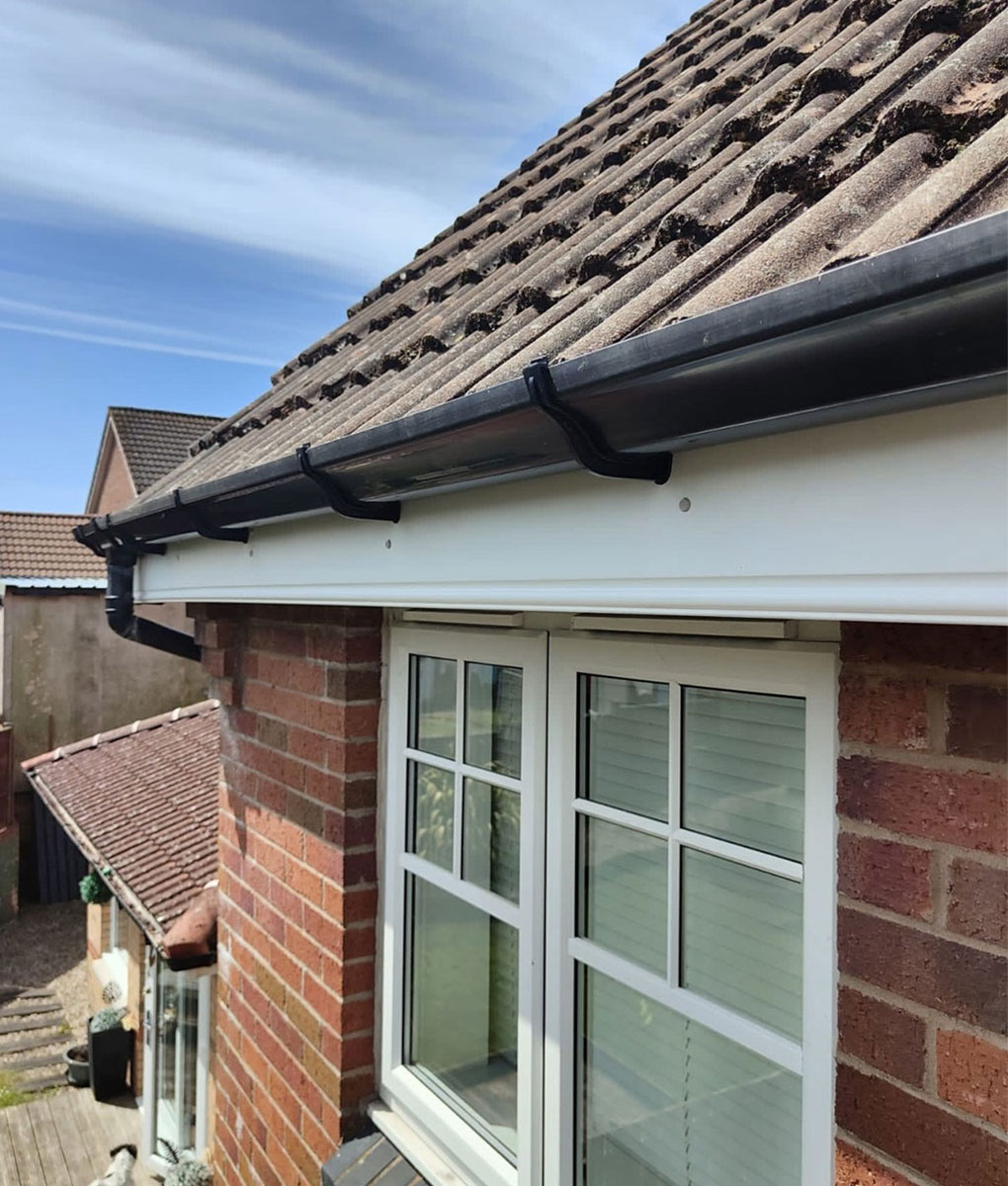
Fascias, soffits and gutters carry rainwater away from the walls. When they fail, damp follows, so they belong early in the programme. We fit uPVC fascias and soffits, repair and replace gutters and downpipes, and fit box ends and bargeboards. Details are on our fascias, soffits and guttering page.
Flat Roofing for Edenbridge extensions and garages
Extensions, garages and outbuildings are often part of a refurbishment, and many have flat roofs. We install and repair flat roofs whether the covering is EPDM rubber, GRP fibreglass, torch on or felt, and put right leaks, blisters, weak edges and poor drainage on existing ones.
Chimney Repairs in Edenbridge
Chimneys on older houses are a common source of damp in upstairs rooms. Our chimney repairs include repointing, rebuilding, capping and removal, with new lead flashing where the stack meets the roof. If a chimney is to come out as part of the refurbishment, we take down the stack, close the roof over and replaster indoors.
Common questions about refurbishing in Edenbridge
What order should the work go in?
Work from the outside in and from the top down. Make the roof, chimneys and gutters watertight first, then the walls and pointing. Deal with damp and give the walls time to dry. Structural changes come next, then plastering, kitchens and bathrooms, flooring and tiling. Decorating is the last job. Done in this order, nothing finished has to be undone.
Can a listed building be refurbished?
Yes, but get consent first. Work that affects the character of a listed building needs listed building consent from the local council, and that applies indoors as well as out. Speak to the council’s conservation officer before fixing a plan. We can help with planning applications, surveys and drawings, and we use traditional methods on heritage buildings where they are required.
How do you deal with damp before decorating?
Find the cause, fix it, then wait. A survey shows whether the moisture is rising from the ground, coming through the wall or forming as condensation. Once the cause has been dealt with, the wall has to dry out, and a thick wall dries slowly. Damaged plaster is then replaced, and only after that does the paint go on. Paint or paper put over a damp wall will peel.
Talk to us about your Edenbridge property
CRB Roofing Building Ltd is a family run firm with three generations of roofing and building experience. We carry full insurance, guarantee what we do and hold Trustatrader approval. To arrange a free site visit, contact us.